
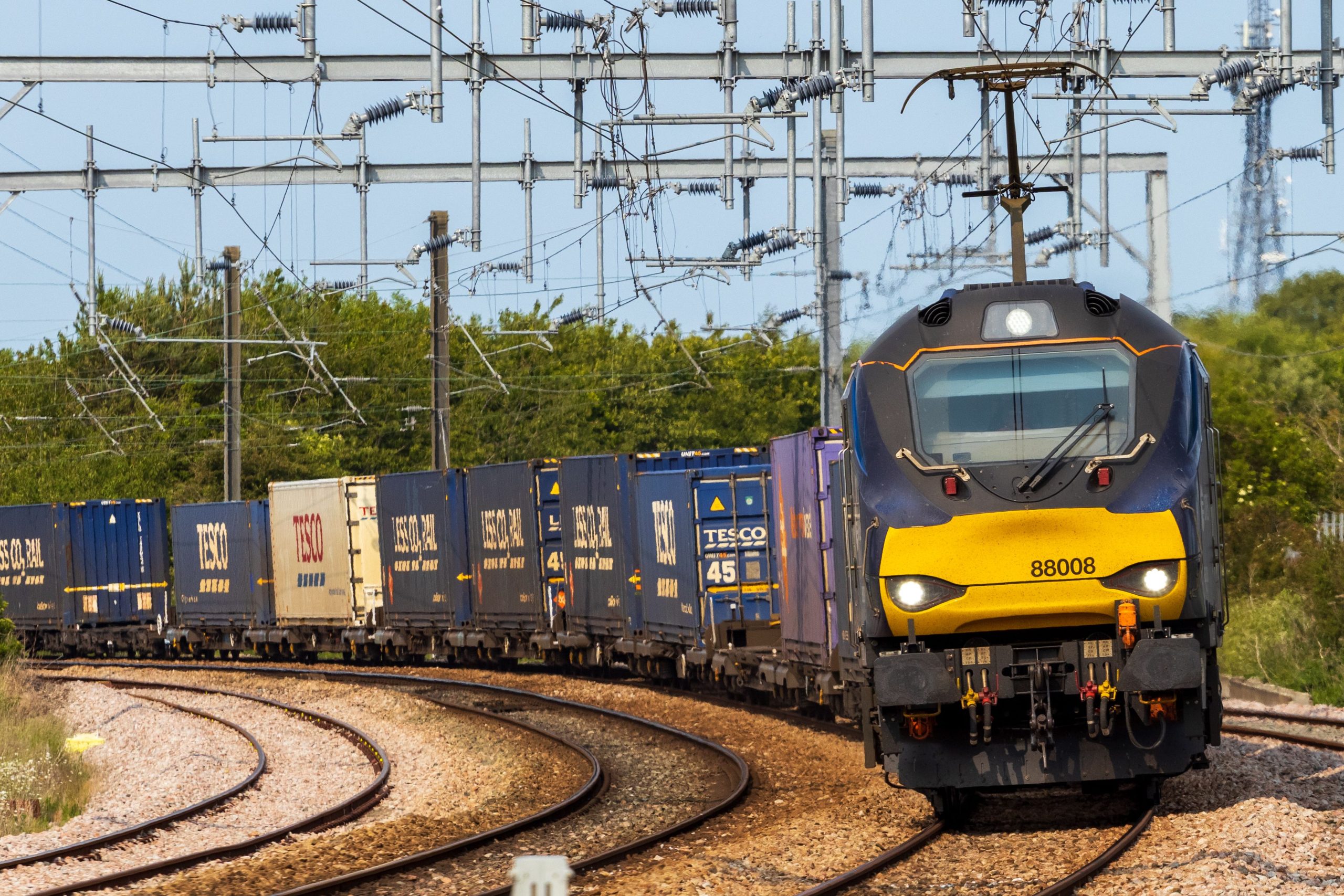
Tesco is marking 20 years of using rail freight to move goods across the UK, highlighting how rail has become an established part of its distribution network rather than simply an alternative to road transport. The supermarket launched its first rail service between Daventry and Scotland in 2006 and has since expanded its network to ten regular services each week, with an additional service operating during the Christmas period.
The scale of that network has continued to grow. Tesco now moves an average of around seven million cases a week by rail, with 40 of its suppliers also using the service. Its rail network has developed beyond traditional dry freight, with refrigerated and frozen services introduced as the retailer has looked for more opportunities to move goods away from the road network.
The development of Tesco’s rail operation also demonstrates how rail can work alongside road rather than replacing it entirely. The retailer’s Daventry International Rail Freight terminal provides an integrated road-to-rail operation, while its more recent services have allowed goods to be moved closer to stores by rail before using road vehicles for the final part of the journey. Tesco’s tenth rail service, launched in 2024, moves around 600,000 cases a week between Daventry and Trafford Park, replacing more than 90 lorry journeys each week and saving more than 6,000 tonnes of CO2e annually.
For Tesco, the case for rail is therefore both environmental and operational. Transport represents a significant proportion of the Group’s emissions, making the way goods move around its network an important part of its wider sustainability strategy. Expanding rail freight, alongside other measures to reduce transport emissions, gives Tesco another way to move large volumes efficiently while reducing its reliance on road freight for longer journeys.
Rail is just one part of a much wider transport decarbonisation programme for the retailer. Tesco is working towards a fully electric UK home delivery fleet by 2030 and is also transitioning its distribution fleets towards lower-carbon alternatives where suitable technologies and infrastructure are available. Its wider work includes electric vehicles, alternative fuels, electric refrigeration units, backhaul optimisation and other measures designed to improve the efficiency of its logistics operations.
These actions sit within Tesco’s wider Planet Plan, which includes a commitment to reach net zero across its own operations by 2035 and across its full value chain by 2050. Transport is an important part of that challenge, particularly given the scale and complexity of Tesco’s supply chain. Rather than relying on one solution, the retailer is taking a broader approach that combines changes to its vehicles, infrastructure, operations and the way goods move through its network.
This is where the wider role of multimodal transport becomes particularly relevant. Rather than viewing road and rail as competing options, businesses can use different modes where they are best suited to the journey. Rail can provide an efficient option for moving larger volumes over longer distances, while road transport offers the flexibility needed for collections, deliveries and the final part of a journey. For businesses managing complex supply chains, combining these strengths can create a more flexible approach to reducing emissions without compromising operational requirements.
Tesco’s experience demonstrates that modal shift does not necessarily mean moving away from road transport altogether. Instead, it is about understanding where changes to the way goods move can work within an existing network, taking into account factors such as distance, volumes, infrastructure and delivery requirements. As businesses face increasing pressure to reduce emissions, these decisions are becoming an increasingly important part of supply chain strategy.
The growth of multimodal transport also highlights a wider shift in how logistics businesses are approaching decarbonisation. There is no single solution that will work across every supply chain, and the most effective strategies are likely to combine different technologies, transport modes and operational changes. For logistics and supply chain teams, the challenge is increasingly about finding the right combination for their network and making those changes commercially viable.
Tesco’s 20 years of rail freight show what can be achieved when alternative transport modes become part of a long-term logistics strategy. As the sector looks towards lower-carbon and more resilient supply chains, experiences such as this demonstrate that modal shift can be a practical part of the transition, particularly when road, rail and other transport solutions are considered as part of the same network.
If you want to explore what it really takes to move towards lower-carbon logistics, join us at Sustainable Logistics LIVE London this November. Bringing together sustainability leaders, logistics managers and supply chain professionals, SLL2026 will explore practical, commercially viable approaches to reducing emissions and accelerating change across the sector. From modal shift and EVs to data, technology and collaboration, the focus is on what businesses can actually do next. Register now: Sustainable Logistics LIVE 2026 London Tickets, Tuesday 10 November • 9 AM – 4:30 PM | Eventbrite
Read Tesco’s 2026 Sustainability Report: Tesco Sustainability Report 2026